

Remember: to improve your balance, you need to work on micro-corrections (fingers) and macro-corrections.
The longer you micro-correct, the less you macro-correct, the better.
To improve micro-corrections, you want to work on:
- timing and body awareness
- technical stamina
- quality of the finger corrections
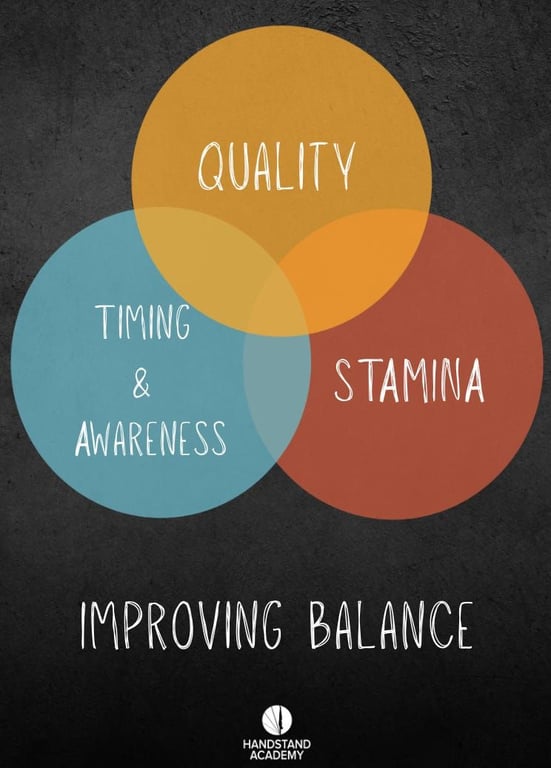
The following tool is about quality.
Let’s go back to our finger 101.
Pushing and relaxing have been the two sides of the same coin.
Push and relax on time, and you stay within the boundaries of your balancing zone.
Push a bit too hard and you timber. Relax a bit too late and you timber. Push a bit too late and you bail.
When you improve your timing and awareness, you learn to relax and push on time, allowing you to stay more centered in the balancing zone and hold longer.
In terms of quality however, we can start trade the jerky ON & OFF motion of our hands for a continuous, precise push adapted to the intensity of our fall.
Picture a car parked downhill. You’re behind the wheel, on foot on the pedal, releasing the handbrake. Your foot isn’t all the way down to the floor. It is pressing “just enough”. Relax it a bit and the car starts rolling forward. This is the level of continuous pressing we want to experience.
This requires excellent body awareness - and may not lend itself to tired days.
Protocol:
- C2W and B2W, take off with one normal ping pong. You can hold it for longer if you like, but keep some energy for the next rep.
- Come back to the wall. Now, just like the braking pedal in our car above, push just enough to make the foot stop and stay as still as possible in the air. This is better experienced C2W, where you can engage the fingers before you take off, and then a tiny bit more once you decide to take off.
- We are basically trying to delay the moment at which a second, noticeable push happens.
 Made with Bullet